
Upcycled sculpture art is made by taking a discarded industrial object, a piece of farm equipment, a stack of tires, an old heating hood, and rebuilding it into a new form rather than melting it down for scrap. The object stays recognisable. In my studio the work runs from finding the piece, through cutting and structural rework, to a powder-coated finish built to survive outdoors.
What “upcycled” actually means in sculpture
Recycling and upcycling get used as though they were the same word. They are not. Recycling breaks a material down to feedstock. A steel drum is shredded, melted, and comes back as something with no memory of what it used to be. Upcycling leaves the object intact enough that you can still read it.
That distinction matters more in sculpture than almost anywhere else, because the recognition is the point. When someone walks up to Rusty Can on Can and works out that the base is half a wood chipper, the piece has done something a fabricated form could not. It carries the labour that came before it. That is the whole basis of my recycled and upcycled sculpture.
So when people ask what upcycled sculpture art is, the short answer is this: sculpture where the previous life of the material is part of what you are looking at. That is also what separates it from recycled material sculptures in the industrial sense, where the source is gone by the time the object is made.
Where the material comes from
When I bought the property in Forestville, the farm equipment came with it. Rusted drag grates, transmissions, cider presses, early model car frames, wood chippers. Decades of agricultural machinery left where it stopped working. There was no sourcing strategy. It was already in the field.
The rest comes from salvage yards, which I still rummage through regularly, as much for ideas as for parts. Surf and Burn started that way. I found the surfboard and the fireplace mantle in the same yard and liked the argument between them: stern, unforgiving cement against a frivolous, floaty plaything. It became three elements, one found, one made, one purchased, and it belongs to the Graveyard series.
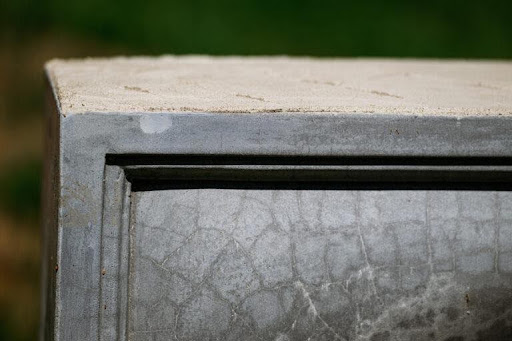
Five pieces and where they came from
The clearest way to explain upcycled sculpture art is to name the objects.
Rusty Can on Can, a retired wood chipper
A piece of farm equipment found in the orchard. I cut the chipper in half, propped it up, and set one of my powder-coated pods on top of it. The pod is new work. Everything under it is not.
Taking Out the Trash, four salvaged trash cans
A ferris wheel made from trash cans. Four salvaged cans painted vivid red, mounted on radiating arms off tilted blue beams. It is the most literal piece I have made about turning refuse into something worth looking at. See it here.
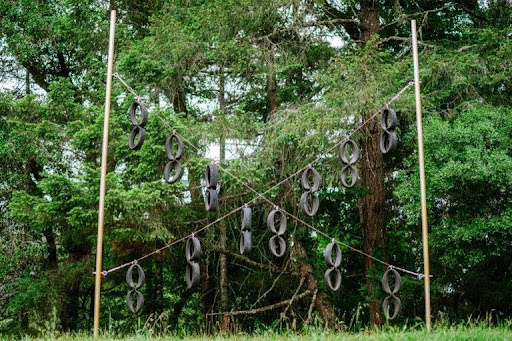
Black Rubber X, repurposed motorcycle tires
I have always been interested in tires. I could spend years just making tire pieces. Here they loop into figure-eight geometry and hang in layered rows between towering poles, vehicular grit set against the landscape behind it. See it here.
Scarecrow, a recycled industrial heating hood
The lofty totem is a staple of my work, and Scarecrow is an imposing example of it. A recycled industrial heating hood sits at the top, supplemented with wood, plastic and metal below. It is the piece people usually point at first when they ask about industrial art sculptures.
Surf and Burn, a surfboard and a fireplace mantle
Described above. Three materials that have no business being in the same sentence, which is exactly why they are in the same sculpture.
What has to happen before a found object becomes sculpture
A found object was engineered for a job that has nothing to do with standing still in a field. A chipper housing was built to be bolted to a frame and to vibrate. Turning it into something that stands on its own, at an angle, permanently, is structural work, and it all happens before any of the visible decisions get made.
The finish decides whether it survives
Material choice gets the attention. The finish does the work.
Pieces are sent to a shop in San Francisco to be powder-coated, specifically so the coating stands up to the elements. Powder coating outdoor sculpture is not the same as painting it. The powder goes on dry and is cured rather than air-dried, which gives a harder and thicker surface than wet paint. On a piece that will sit in a field through summer heat and winter rain for a decade, that difference is the whole argument.
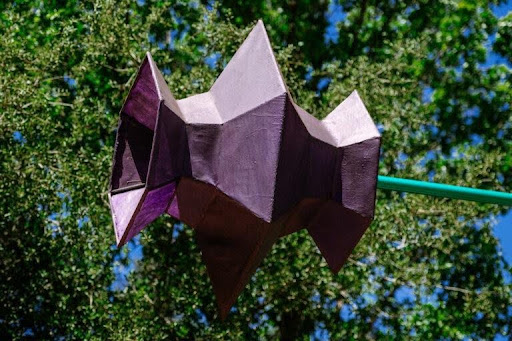
Not everything gets coated. Some works keep their rust, because the rust is the point. The lantern-like pods and the organic boulders use fiberglass, modern resins and foam products, finished in a bright array of colour, which is where the abstract metal sculptures in the collection get their saturation.
How to tell handmade reclaimed work from a mass-produced imitation
Search for salvaged metal art and most of what comes back is production work sold as reclaimed. Some of it is perfectly good decor. It is not what it says it is. Five things separate them.
- Repetition. Look for the same piece listed by more than one seller. Genuine salvage is one-of-one by definition. There was only ever one of that wood chipper.
- Provenance. Ask what the object used to be. A real answer is specific: a wood chipper, a heating hood, four trash cans, a set of motorcycle tires. A vague one, “reclaimed metal”, usually means new steel given a distressed finish.
- Evidence of a previous life. Bolt holes that go nowhere. Weld scars. Old paint under new. Wear where a hand or a belt used to sit.
- Weight and scale. Production decor is light, because shipping costs money. Salvaged industrial material is heavy and behaves like it.
- A named person. You should be able to find who made it, where they work, and where their work has been installed. A reclaimed material artist has a studio and a record of installations. A marketplace listing has neither.
Does reclaimed metal sculpture last outdoors?
More than a hundred pieces are planted across this ranch, suspended from trees, rooted into the ground, standing on poles. Over two dozen have been installed roadside in the past five years by me and my crew. They sit through Sonoma County summers and winter rain.
“Blue Jig & Jag” is installed on Highway 101 in Florence, Oregon through 2028, on the coast, where salt air is a genuine test. “Wedge” went into the City of Sebastopol’s Community Sculpture Garden. Work built from industrial salvage and finished properly is not fragile. It was industrial to begin with. If you want to see how the same material behaves once it is sited outdoors, that is what the outdoor and garden sculptures are for.
Frequently asked questions
What is the difference between recycled and upcycled sculpture?
Recycling breaks material down to raw feedstock. It is melted or shredded and loses its identity. Upcycling keeps the object recognisable and rebuilds it into something new. In an upcycled sculpture you can usually still tell what the material used to be, and that recognition is part of the work.
Where does the material come from?
Two main sources. Farm equipment that was already on the 132-acre Forestville property when I bought it, including drag grates, transmissions, cider presses, early car frames and wood chippers, and salvage yards, which I visit regularly for both parts and ideas.
Is upcycled metal sculpture strong enough to live outside?
Yes. The material was industrial before it was art, and finished pieces are powder-coated at a shop in San Francisco specifically so the coating withstands weather. More than a hundred works stand outdoors on this property, and pieces are installed on the Oregon coast and in public sculpture gardens.
Does reclaimed metal sculpture rust?
Only where it is meant to. Powder-coated pieces are sealed against weather. Some works are left raw deliberately, because the rust is part of what the piece is about. “Rusty Can on Can” is named for exactly that.
Come and see it. More than fifty works stand across the orchard and the grounds at Forestville. If you want to understand how salvaged material behaves as sculpture, the fastest way is to walk around one. Get in touch to arrange a visit.