
Outdoor sculpture installation comes down to three questions, in this order. What is behind it? How will it be held down? And can it physically get to the spot? Most people start with the third and work backwards, which is how a good piece ends up in a bad position.
Start with the view, not the object
A sculpture outdoors is never seen on its own. It is always seen against something: a treeline, a fence, a wall, a stretch of sky, the neighbour’s roof. That backdrop does at least half the work, and it is the thing most people forget to look at.
When “Wedge” went into the City of Sebastopol’s Community Sculpture Garden, the thing that made it work was not the piece standing still. It was that its silhouette kept reframing the landscape behind it as people walked past. The same form read differently from every approach.
I said something similar about placing “Blue Jig & Jag” on the Oregon coast. There is something about putting a large sculpture somewhere the landscape is already doing so much that demands the work earn its place. I wanted it to feel as though it grew out of the ground and had always been part of that view. That is the test for any outdoor sculpture installation. Does it look like it belongs, or like it was delivered? Working that out on site, rather than from a photograph, is what being a site specific sculpture artist actually means.
Six things to look at before you choose the spot
- The backdrop. Stand where people will stand and look past the empty spot. A brightly coloured piece against a dark treeline reads completely differently from the same piece against a pale wall.
- The approach. How do people arrive, on foot, by car, through a gate? A piece meant to greet you should be placed where the eye lands, not where there happens to be room.
- Sun and time of day. Metal and colour change hour by hour. Walk the site in the morning and again in the late afternoon before committing to a spot.
- Distance. Large work needs room to be read. Too close and you only ever see a detail. Too far and the scale collapses.
- The ground. Level, slope, drainage, what happens there in winter. This decides how the piece is held down more than anything else does.
- Access. Gate width, overhead cables, soft ground, turning space. The piece has to get there before any of the rest matters.
How outdoor sculpture is actually held down
This is where most buying guides go quiet. There are four approaches I use across outdoor sculpture installations, and the piece and the site decide which one applies.
Set on a plinth
The piece sits on a prepared base rather than in the ground. This is standard for public work. “Blue Jig & Jag” went onto a designated plinth on Highway 101 in Florence, Oregon, where six sculptures sit at fixed locations along the corridor. It suits sites where you cannot or should not dig.
Mounted on a post
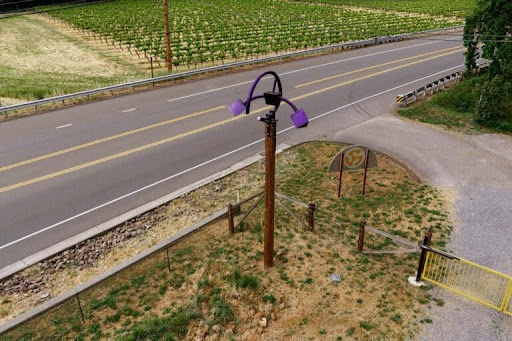
The work is carried above head height on a post. The piece at the entrance to the orchard is mounted high on a weathered wooden post and has stood sentinel over the road below since it was the first thing installed at the farmhouse. Post-mounting lifts a piece clear of planting and gives it a sky backdrop rather than a ground one.
Rooted into the ground
Legs or a stem go below grade into prepared ground. Most large freestanding work on the ranch is set this way. It is the most stable option and the least visible. Done properly, nothing about the fixing shows.
Suspended
Some pieces hang. Across the 132-acre property, works are suspended from trees as well as rooted into the ground and towering on poles. Suspension changes the piece entirely, because it moves.
Wind, weather and the coast
Northern California is not one climate. A piece on the Sonoma County ranch deals with hard summer heat and a wet winter. A piece on the coast deals with salt, which is a different and more aggressive problem.
That is the reason finished work goes to a shop in San Francisco to be powder-coated rather than painted. The coating is chosen so it withstands the elements, and it is what makes the difference between a sculpture that still looks like itself in ten years and one that does not. “Blue Jig & Jag” is on public display on the Oregon coast through 2028, which is about as direct a test of that as you can arrange.
So when people ask does outdoor metal sculpture rust, the answer is only where it is meant to. Coated work is sealed. Some pieces are deliberately left raw because the rust is part of what they are about.
What install day actually looks like
“Blue Slugger” went in at The Living Room in Santa Rosa in July 2026. The photographs below are what the process really looks like: the frame being walked upright by hand and guided down onto its ground mount, then the finished piece with the rusted beam hanging from the apex.
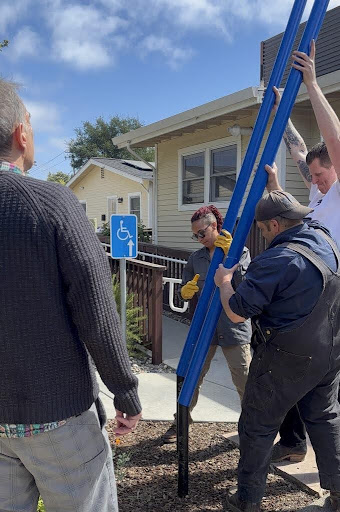
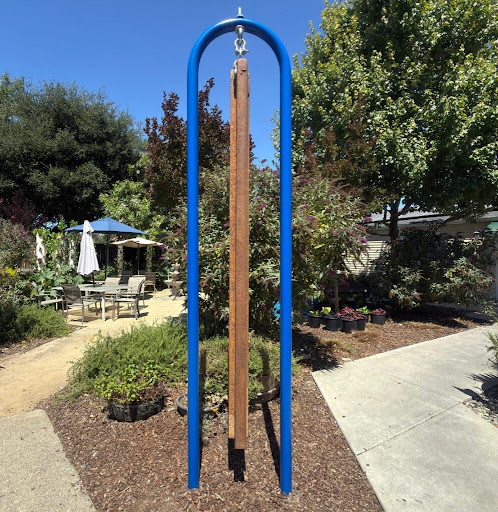
Over the past five years my crew and I have installed more than two dozen originals roadside, on top of everything sited across the ranch. The pattern is always the same. Agree the position on site, prepare the ground, bring the piece in, set it, then stand back and look at it from every approach before anyone walks away. That is what sculpture installation services should mean in practice.
Living with it
Sited properly and finished properly, a large outdoor piece is not high-maintenance. More than a hundred works stand outdoors across this property, some of them for years, and they are not fussed over. Most of the outdoor and garden sculptures available now are built to the same standard.
Frequently asked questions
Where is the best place to put a sculpture in a garden?
Choose the position by what sits behind the piece and where people will see it from, not by where there happens to be space. Walk the garden at different times of day, look at the backdrop from each approach, and leave enough distance for the whole form to be read at once. Most outdoor garden sculptures are placed too close to be read properly.
How is an outdoor sculpture held in place?
Four common ways: set on a prepared plinth, mounted on a post, rooted into the ground below grade, or suspended. Which one applies depends on the piece, the ground and whether digging is possible on that site.
Does outdoor metal sculpture rust?
Powder-coated work is sealed against weather and does not. Some pieces are deliberately left raw because the rust is part of the work. The coating, not the metal, is what determines this.
Will a sculpture survive coastal weather?
Yes, if the finish is chosen for it. Salt air is more aggressive than inland conditions, which is why coating specification matters more on the coast. “Blue Jig & Jag” is installed on Highway 101 in Florence, Oregon and is on public display there through 2028.
Thinking about a piece for a specific spot? The useful first step is almost always a site visit, standing where the work would go and looking at what is behind it. Get in touch and we can start there.
Service area: Forestville and Sonoma County, and across the Bay Area including Berkeley, Oakland, Richmond, San Mateo, Palo Alto and Daly City.